
Sovereign Dispatch #001: The 1953 Blueprint
1 . The "Executive Summary
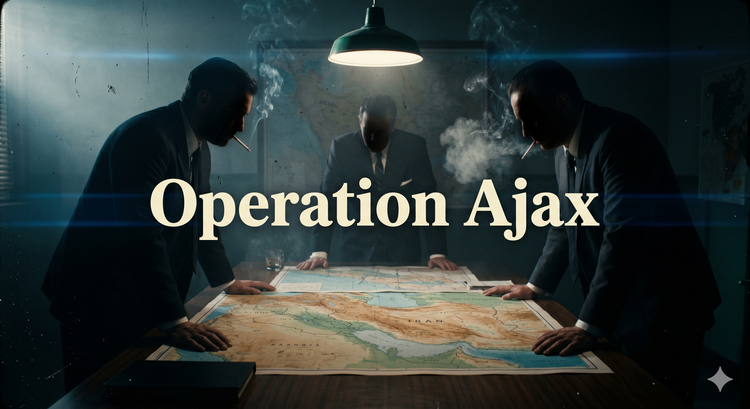
The 1953 coup in Iran was not a one-off event; it was the birth of a geopolitical playbook that is currently being deployed in Iran, Venezuela, Ukraine, and the list is growing of smaller countries who's sovereignty have been threatened or outright compromised because a larger country wants to impose their will. Operation AJAX (1953 the CIA, MI6 plot to overthrow the democratically elected iranian governament at at the expense of the iranian people's democracy was a precedent that set the stage for half a century of radicalization and geopolitical instability, creating a 'Symmetry of Interference'where the very methods used to secure western interests in 1953 became the primary drivers of anti western sentiment in the modern era. Corporate resource extraction was prioritized over the self determination of states.
The Parallel: 1953 Tehran vs. 2025 Damascus
The 1953 plot to overthrow the democratically elected Iranian government at the expense of the Iranian people's democracy was a precedent that set the stage for a recurring geopolitical playbook: the managed collapse of "uncooperative" states to clear the path for Western-aligned stability. Just as the CIA and MI6 exploited internal Iranian grievances to dismantle a burgeoning democracy, we see the echoes of this strategy in the rapid fall of the Assad regime and the subsequent installation of Ahmed al-Sharaa (formerly Abu Mohammad al-Golani). In both instances, the primary objective was not the organic restoration of popular will, but the surgical removal of a regional "spoiler"—Mosaddegh in '53 for his oil nationalization, and Assad for his alignment with the "Axis of Resistance."
The symmetry between Tehran and Damascus lies in the acceleration of the vacuum. In 1953, the "Behbahani dollars" manufactured street chaos to justify military intervention; in the Syrian context, the sudden pivot of al-Sharaa from an international pariah to a pragmatist suited for governance suggests a similar "normalization" process managed by external power brokers. By installing a leader whose legitimacy is tied to his ability to secure transit corridors and check Iranian influence, the modern "Sovereignty Playbook" remains unchanged: the self-determination of a people is often treated as a secondary casualty to the strategic necessity of a compliant regional partner.
2 . The Informed Commentary: "The Archival Lens"
I. The Myth of the "Spontaneous" Riot
The "spontaneous" uprising of August 1953 serves as the definitive case study in the manufacturing of synthetic dissent. By channeling "Behbahani dollars" through clerical networks to hire street agitators and professional muscle, the CIA and MI6 created a kinetic illusion: the appearance of a populist rejection of Mosaddegh that masked a meticulously funded operation. In 2026, the suitcase of cash has been replaced by the botnet and the algorithmic amplification of domestic grievances, yet the blueprint remains identical. Sovereignty is not necessarily lost at the barrel of a gun; it is surrendered the moment a nation’s domestic information space is successfully infiltrated and turned against itself, transforming citizens into unwitting proxies for foreign strategic interests.
II. Energy as the Ultimate Lever
While the geopolitical theater has expanded to include the "white gold" of lithium and rare-earth minerals, the foundational blueprint remains lubricated by oil. The 2011 overthrow of Muammar Qaddafi serves as a modern masterclass in this reality, proving that "regime change" is often the penalty for attempting resource independence. Qaddafi’s fatal error was not a lack of democratic reform, but his move to establish a gold-backed African dinar—a direct challenge to the petrodollar system that would have forced the West to purchase Libyan crude on his terms. Much like Mosaddegh in 1953, Qaddafi attempted to exert true "Energy Sovereignty" by using his nation's vast reserves as a lever for regional autonomy. In both eras, the result was a coordinated intervention that prioritized the security of global energy transit and currency dominance over the actual stability of the sovereign state.
3. "The Strategic Comparison" (Table)
|
Feature |
1953 Operation (Iran) |
2026 Equivalent (Global) |
|
Primary Lever |
Suitcases of Cash / Radio |
Digital Currency / Botnets |
|
Casus Belli |
Oil Nationalization |
Self Determination |
|
Proxy Force |
Street Mobs / Clergy |
Military |
4. Closing Argument: "The Sovereign Outlook"
Ultimately, the lessons of 1953 and 2011 reveal that the architecture of global power is designed to resist the emergence of truly independent actors. Whether the leverage is a suitcase of currency or a coordinated cyber-assault on a resource-rich state, the objective remains the same: to ensure that no nation’s wealth—be it oil, lithium, or data—is ever fully removed from the reach of established centers of control. As we navigate the provocations of 2026, it is clear that the "blueprint" has not been retired; it has simply been refined for an era of hybrid warfare.
If we fail to recognize the mechanics of 1953 in the headlines of today, we remain perpetually vulnerable to the same engineered collapses that leave nations hollowed out by foreign wars, crippled by staggering national debt, and prey to the very terrorism that often germinates in the vacuum of a dismantled state. True sovereignty is not a static achievement to be celebrated, but a relentless and vigilant defense of the national archive, the national resource, and the national mind against a playbook that never sleeps.
Member discussion